
“We are going to launch our corporate-wide new ESG policy. We want to do this in a fast-paced, energetic, light-toned talk show, but we also want to show a lot of the content. We want to show the broad scope of this document, the many enthusiastically involved internal stakeholders, and the broad support of management and board. So yes, you have 21 speakers and we only have 60 minutes.”
Organizing an event with many speakers — especially corporate launches or policy rollouts — often leads to one major execution challenge: too much content, too little time.
Of course, one of the most obvious solutions is to reduce the number of speakers. Many people are given a role out of courtesy or to make sure they feel included, but they are not necessarily improving the experience for the participants or helping you achieve your goals. In many cases, there are other ways to give people a role, make them feel important, and show their commitment without taking up stage time.
In this case, however, the wide array of speakers served an important purpose: highlighting the richness and diversity of the document. We did eliminate a few speakers that felt like duplicates, but overall the broad mix of voices was essential. So I took it as a challenge and said: “Let’s do this — and let’s do it within one hour.”
In this article I’ll share the practical, repeatable principles that made it work — principles you can use for corporate events, conference sessions, policy launches, and executive panels.
Why Traditional Speech Formats Fail
Event planners and conference organizers face a common problem: speakers tend to prepare speeches, not conversations. Even with the best intentions and sincere promises to keep it short, monologues expand, timing slips, and by the time you reach your tenth speaker, you’re already over schedule.
This is because traditional presentation formats treat each contribution as a standalone unit, often without strong alignment to the overall narrative of the event.
We needed a different approach: no monologues, only interviews, guided by a moderator. Turn your event into a talk show and you gain much more control over the message, the mood, and the timing. The energy stays higher, and you keep the focus on the messages you actually want to land.
8 Principles That Made 21 Speakers Fit into 60 Minutes
1. No Monologues — Only Interviews
Replacing speeches with moderated interviews gives you much more control over time, tone, and message coherence. An interview format ensures contributors stick to the point and keeps the energy high throughout.
2. Define Clear Roles for Everyone — and Make Them Visible
Not all participants are key speakers. Some are sidekicks, topic owners, supporters, or amplifiers. Naming roles prevents repetition and creates a clear rhythm between segments.
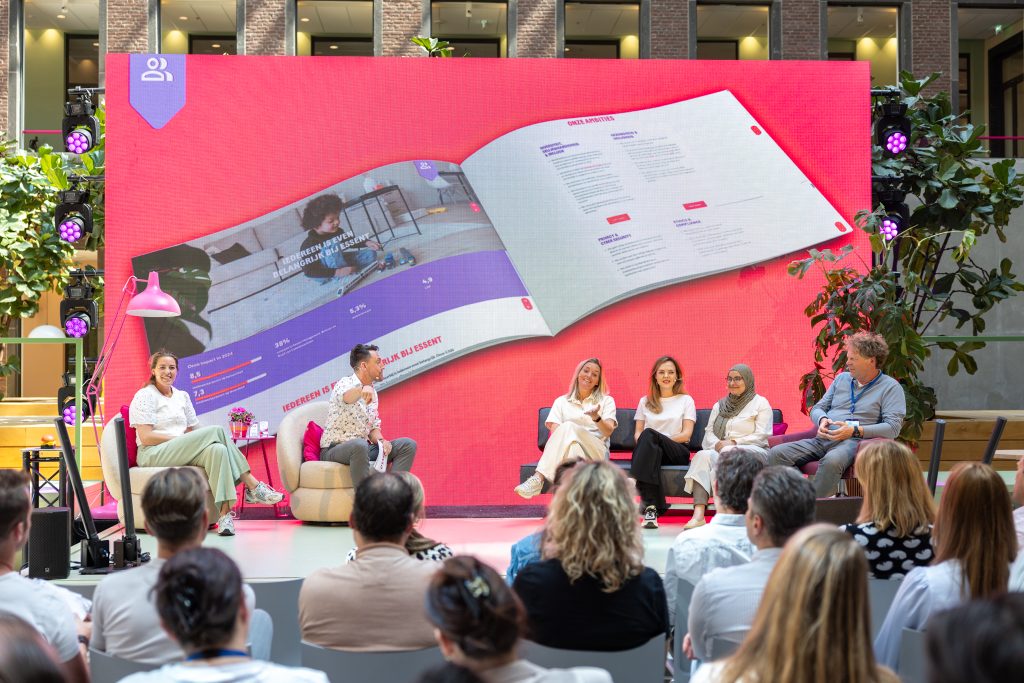
In this event, we chose three topic leads as key guests for each theme. To make this visible, they were seated on chairs to my right. Their strategic and overarching messages were further illustrated and detailed by people with more specific contributions, seated together on a couch to my left. This illustrared their different role and also made it look cosy.
Some contributors with very specific input joined briefly from the audience. For this, I threw a catchbox microphone. Besides illustrating their different role, this also reduced the distance between stage and audience — important, because with this many speakers and limited time, there was hardly any room for traditional audience interaction.
At the end, the full board of directors came on stage to hit the launch button. Because they did not give lengthy content-driven speeches, this moment reinforced that the policy was not a top-down initiative, but a company-wide policy but that they supported it very much.
3. Start from the Core Message
Most speakers only had a few sentences, or maybe one or two minutes. That meant we went straight to the speaker’s actual point — the insight or decision the audience needed to remember. No warm-ups, no context-setting, just what mattered.
4. Focus on Interest, Not Completeness
Too many speakers and organizers aim for completeness. “We shouldn’t forget this.” “This is also important.” Trying to cover everything dilutes impact. Instead, choose one compelling example or striking item per topic and focus on that. You mention less, but more sticks.
5. Skip Self-Introductions
When speakers introduce themselves, it often turns into a long and humble CV reading that delays the substance. Instead, the moderator handles brief introductions, makes roles clear, and moves directly into the content.
6. Pre-Event Briefing Is Critical
Before the talk show, we had a lunch with all speakers where we briefed them again on the format and checked with each speaker:
- their role
- their core message
- and that the goal was conversation, not performance
This helps reduce nervousness and prevents stiff panel behaviour.
7. Minimise Content — So There Is Time Left for Spontaneity
By being very strict and quite ruthless about the core messages, not only did everything fit into 60 minutes, we even had time left. That meant the event was not a race against the clock, but had room for a joke, an anecdote, or a spontaneous follow-up — without running over time.
8. Align Strongly with Your Client
At every event there are people with special requests. A few minutes extra. A slide deck. A personal announcement. Before you know it, a strong format gets diluted by internal politics and old habits.
My absolute saviour here was the internal event manager. We shared a very clear vision of what the event needed to be. She defended the format strongly and managed speaker expectations internally. At the same time, she did not micromanage the conversation, but trusted me to shape the flow and ask the right questions.
Too often I see the opposite: clients who are very flexible when it comes to speaker requests, but at the same time try to micromanage every detail of the script, sometimes even providing fully written text to be read out loud. That combination almost always leads to endless coordination and a stiff, amateurish end result.
In this case, strong alignment and mutual trust were a major factor in success.
Conclusion
Designing a successful multi-speaker corporate event is not about squeezing more content into less time. It is about making clear choices in event format, speaker roles, and moderation. By working with interviews instead of monologues, focusing on core messages, and aligning closely with the client, it is possible to deliver complex content in a way that stays focused, energetic, and on time.
These principles apply to ESG launches, policy rollouts, conferences, and executive panels where many stakeholders need to be visible without losing narrative control. With the right structure and strong moderation, even 21 speakers can fit into 60 minutes — without compromising clarity or impact.
