

“Panels: there is a stubborn misconception that they are mandatory — and that they have to be tasteless.”
Article Summary
- Panel discussions are not mandatory, dare to skip/replace them.
- Panel discussions are not inherently boring, if you redesign them they can be great to create meaningful audience engagement.
- Panels fail when they are treated as default formats rather than deliberately designed conversations.
- Avoid the word ‘panel’ and ‘panelist’: It sets poor expectations of audience and speakers. Rename it to help you define your goals and setup.
Panels at events in the Brussels bubble are a bit like Brussels sprouts.
Force-fed all the time.
No discussion about it.
Most of the time tasteless.
And lukewarm received
In policy conferences, stakeholder forums and institutional events, the panel discussion is treated as a default format. It “belongs.” People expect it. Nobody seriously questions whether it should be there. Nobody reaaaaly likes them. But if you want to grow big, you have to eat them.
But why? Panels are not mandatory. There is no law that says you have to serve them. There are countless alternative formats that are often more engaging, more dynamic and more effective than a traditional panel. Interviews. Discussions. Debates. Interactive workshops. Curated dialogues.
So one option is to skip them. The other is to change the recipe.
Panels are not the problem. Boring panels are.
Nobody enjoys eating the same overcooked, mushy Brussels sprouts every day. But prepared well, Brussels sprouts can be excellent. Roasted. Grilled. Stir-fried. Combined with unexpected flavours. Served with intention.
Panels work the same way.
A panel is not inherently dull.
A poorly designed panel is.
When panels are treated as a checkbox, and served without a good recipe, you get the same result: long monologues, vague agreement, little energy, no outcome.
But when panels are deliberately designed, they can be sharp, lively and genuinely valuable.
Ten ways to rethink a panel discussion
(from small adjustments to fundamental redesigns)
- Tight moderation and strict timing
The smallest change, but often the most effective. Short answers, no monologues, active interruption when needed. Panels improve immediately when time is treated as a design constraint. - Not individual questions to panelists, but discussion topics/questions/dilemma’s to the whole panel
Now they interact with each other and it becomes a conversation. The moderator controls the flow and avoids repetition and dominance by the loudest voice. - The Moderated Interview Series
The panel becomes a sequence of short interviews. Each speaker is questioned individually, allowing for focus, clarity and narrative control. - The Case-Driven Panel
One concrete case or scenario is central. All speakers respond to the same input, forcing specificity and practical relevance. - The Audience-Integrated Panel
Audience input is built into the structure from the start — through polls, curated questions or live prompts — instead of being squeezed into the last five minutes. Let the panel react to the audience. Let them question the audience. Let them judge the audience or reach a verdict. Turn your audience into speakers, your speakers into judges. - The Structured Disagreement
Speakers are briefed to defend a clearly articulated position. The moderator actively surfaces contrasts instead of consensus. This only works if real differences exist. - The Fishbowl Conversation
Speakers rotate in and out, sometimes joined by participants from the audience. This reduces hierarchy and keeps the discussion dynamic. - The Expert Reaction Panel
Instead of discussing abstractly, speakers respond to short provocations: a statement, a data point, a quote or a short video. Reaction replaces repetition. - The Dialogue with the Room
The panel dissolves the stage–audience divide. Speakers and participants are part of the same structured conversation, guided by the moderator. - Replace the panel altogether
The most fundamental change: decide not to have a panel at all. Use interviews, workshops, debates or facilitated conversations if those formats serve the objective better.
The most important tip: do not call it a panel
This is not a gimmick. It is a strategic choice.
Replace the word ‘sprouts’ on the menu with ‘stir-fried Brussels green-gold’ and the anticipation turns 180 degrees!
First, the word panel triggers expectations.
Most attendees already think: “Oh. A panel. This will be booooooooring”
Speakers arrive with pre-programmed behaviour: prepared talking points, polite agreement, long answers.
Give the session a different name, and people become more open to a different experience.
Second, if you stop calling it a panel, you are forced to think.
What is this session, really?
- Is it a discussion?
- A discussion with the audience?
- A debate?
- A dialogue?
- A collective sense-making exercise?
And if it is a discussion: are there actually different perspectives?
Because if there are no differences, it is not a discussion.
This is not a semantic exercise.
It is a design exercise.
Being precise about what the session is helps you define:
- what you want the audience to take away,
- how the session should be structured,
- and how speakers should be briefed.
Don’t call your speakers panelists
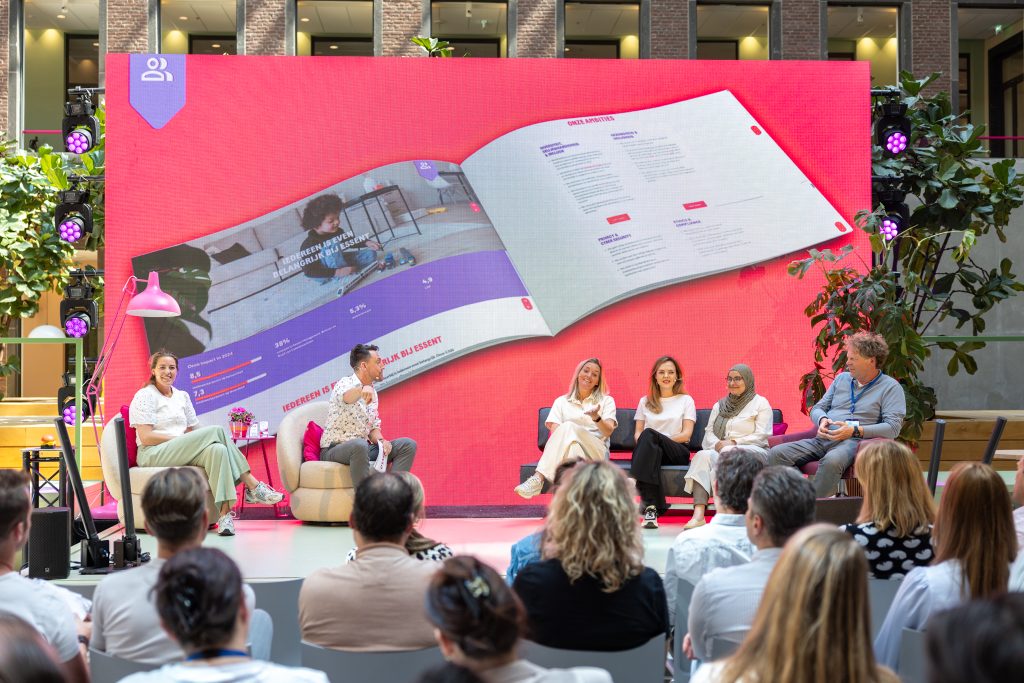
In the same way: don’t invite people to be ‘on the panel’.
Give them a role: introducer, reactor, jury, judge, expert opiniator, outsider, troll, joker, grandpa’s of the muppets, topic owner, topic roaster. etc. Define why you ask them and what role they have.
And: not all speakers need to have the same role. On a panel, all panelists are equal (even though the almighty protocol will dictate who gets to speak first) with equal speaking time, equal questions qnd equal place. But if you differentiate, you cane be much more playful, meaningful and purposeful in the role you assign people. See this article.
Design panels the way you would cook Brussels sprouts
Every time you cook Brussels sprouts, you should ask yourself:
- How do I want to prepare them this time?
- What do I actually feel like eating?
- What fits this moment?
Panels deserve the same question.
Not: “We should have a panel.”
But: “What kind of conversation do we need — and how do we design it well?”
When you start there, panels stop being a necessary evil.
They become a deliberate choice.
And sometimes, even a highlight.
Design conversations, not panels
At high-level policy events, time is scarce and attention even scarcer.
Participants do not attend to hear what they already know — or could read elsewhere.
Design your sessions the way you would cook Brussels sprouts:
- with intent,
- with variation,
- and with awareness of context.
When you do, panels stop being a necessary evil.
They become one of several deliberate design choices.
Working with Moderating.eu
At Moderating.eu, we help EU institutions, networks and organisations design conversations that actually move people — and policy — forward.
Not by abolishing panels as a rule.
But by questioning them, redesigning them, or replacing them when needed.
If you are organising a Brussels-based policy event and want sessions that are sharper, more engaging and more effective, we should talk.
Because the format is never neutral — it shapes the outcome.
Topic: Panel discussions at conferences and events
Core idea: Panels are not inherently boring; poorly designed panels are.
Article summary
- Topic
- Panel discussions at conferences and policy events
- Core idea
- Panels are not inherently boring; poorly designed panels are. By clearly defining the purpose of a session organizers can structure conversations more effectively, brief speakers more precisely, and deliver greater value to audiences.
- Summary
- Panel discussions are widely used in conference and policy settings, particularly in Brussels-based events, but are often perceived as ineffective. The article argues that this is not due to the panel format itself, but to a lack of intentional design. It presents ten ways to redesign panels, ranging from minor moderation improvements to replacing panels entirely with alternative formats.
- Key concepts
- Panel design, event moderation, conference formats, audience engagement, policy events
